Explore the origins and application of backcasting as a strategic planning method that helps leaders design the future by working backward from long-term goals.
A Strategic Method for Designing the Future by Working Backward
In an era defined by rapid technological disruption, economic volatility, and societal transformation, traditional planning methods that extend current trends into the future are no longer sufficient. Many strategies remain constrained by present realities, limiting the possibility of transformational change. Backcasting offers an alternative. Instead of asking where current trajectories will lead, leaders begin with a clearly defined desirable future state — often 10 to 20 years ahead — and work backward to determine the policies, capabilities, and decisions required today to reach that future. This shift transforms strategy from a predictive exercise into a deliberate act of future design.
In an era defined by rapid technological disruption, economic volatility, climate pressures, and accelerating societal change, traditional strategic planning methods that simply extend present trends into the future are increasingly inadequate. Many organizations remain constrained by current realities, optimizing within existing systems rather than reimagining what could fundamentally be different. Backcasting offers a powerful alternative. Instead of asking where today’s trajectory will lead, leaders begin with a clearly defined, desirable future state — often 10, 15, or 20 years ahead — and then work backward to determine the decisions, capabilities, and systemic shifts required today to make that future possible. This shift transforms strategy from a predictive exercise into a deliberate act of future design, allowing organizations to break free from incremental thinking and pursue transformational outcomes.
Origins and Evolution of Backcasting
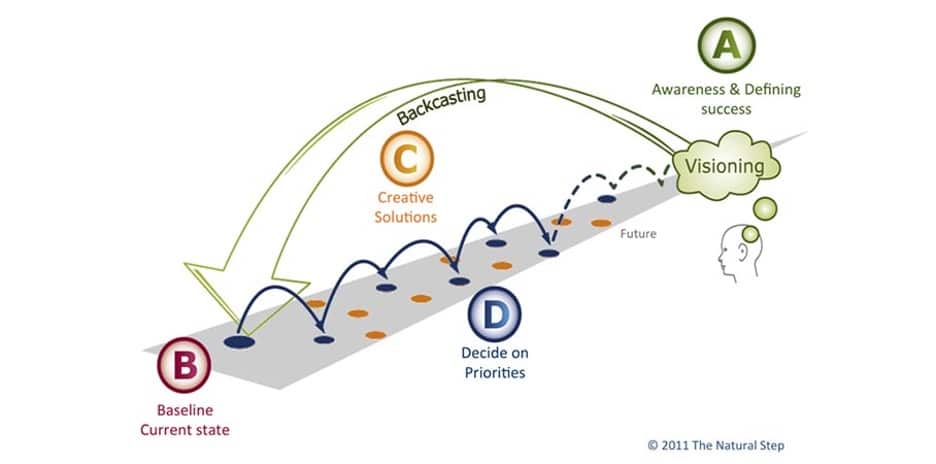
Backcasting emerged in the 1970s and 1980s within the fields of environmental and sustainability planning, where researchers recognized that prevailing industrial trends would not lead to a sustainable future. One of the early pioneers was Dr. Karl-Henrik Robèrt, founder of The Natural Step, which applied backcasting to define sustainable future conditions and guide present-day policy and organizational decisions. The method was later adopted by strategic foresight communities and discussed in management thought leadership forums, including contributions linked to MIT Sloan and Harvard Business Review, expanding its use beyond sustainability into corporate strategy, digital transformation, and long-term institutional reform.
What Is Backcasting?
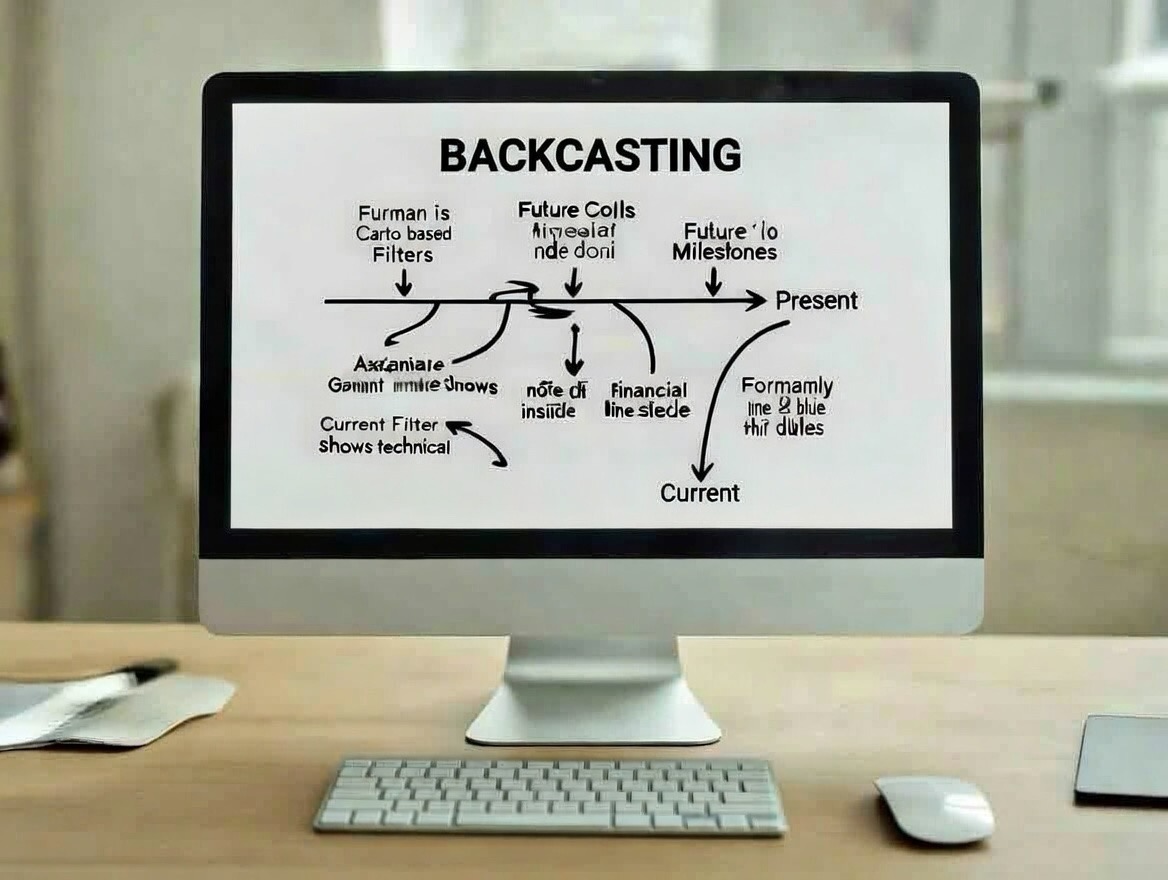
Backcasting is a normative, future-oriented planning method that starts with a clearly articulated vision of a desirable future and then reasons backward to identify the actions required to reach it.
Backcasting is a normative planning method that:
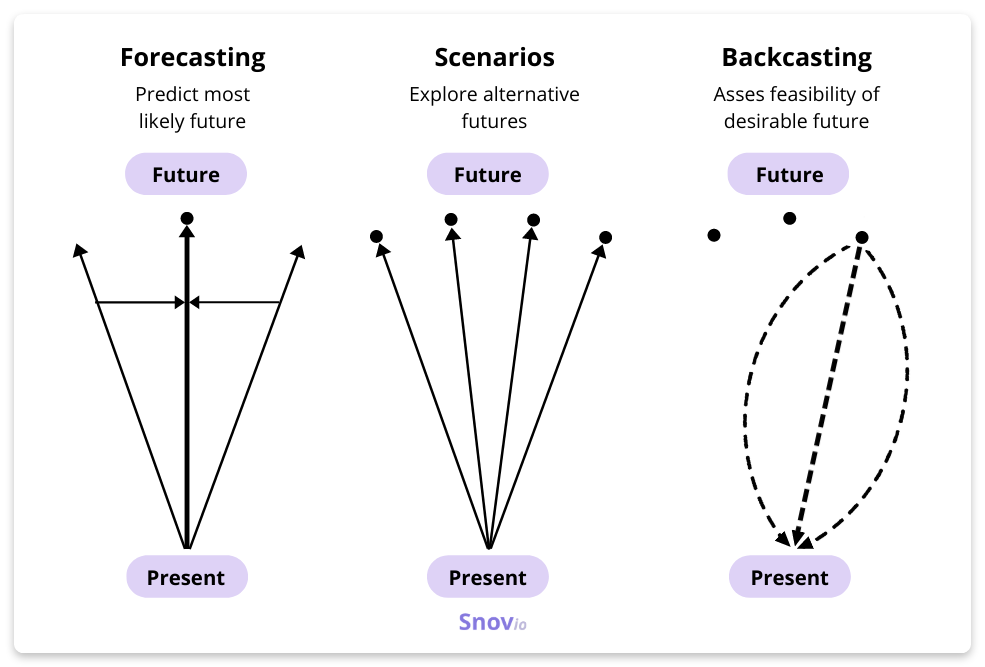
It asks not “What is likely to happen?” but “What must we start doing today to create the future we want?”
Backcasting represents a fundamental shift in strategic leadership thinking. It frees organizations from the constraints of present conditions and enables leaders to envision a fundamentally different future before designing the path toward it. Originating in sustainability science and later embraced in strategic management discourse, backcasting helps organizations move from reactive adaptation to intentional transformation. In a world of growing uncertainty, it equips leaders with a structured way to align present decisions with long-term aspirations. Organizations that plan from the present often achieve incremental improvements; those that plan from the future gain the opportunity to reach an entirely new destination. Backcasting is therefore not just a planning technique — it is a strategic leadership discipline that redefines how the future is imagined, designed, and realized.
When Is Backcasting Most Valuable?
Backcasting is particularly powerful when:
In these contexts, forecasting tends to extrapolate the present, while backcasting liberates strategic imagination and anchors action in a preferred future.
Backcasting Compared to Other Strategic Planning Models
| Method | Starting Point | Type of Thinking | Primary Use |
|---|---|---|---|
| Forecasting | Present | Trend extrapolation | Short- to mid-term operational planning |
| Scenario Planning | Present | Exploring multiple plausible futures | Managing uncertainty and risk |
| Roadmapping | Present | Sequencing development steps | Technology and innovation planning |
| Backcasting | Future | Normative reverse design | Transformational and long-term change |
Backcasting is distinctive because it is normative — it begins with a preferred future, not merely a probable one.
A Professional Framework for Applying Backcasting
Effective backcasting begins with defining a clear, measurable, and compelling future state rather than a vague aspiration. Leaders then conduct a strategic gap analysis to identify the differences between current capabilities and future requirements. From there, they map a backward transition pathway, breaking the journey into time-based phases and identifying key milestones. Critical early transformation decisions are identified — those that fundamentally shift direction and cannot be postponed. Investments, policies, and initiatives are then aligned with the future vision rather than legacy models. Organizations establish future-oriented performance indicators that track progress toward the envisioned state, not only short-term efficiency. Finally, the pathway is reviewed adaptively, allowing tactical flexibility while maintaining a stable long-term destination.
Practical Examples of Backcasting in Action
Energy and Climate Strategy: Several Nordic countries have used backcasting to define carbon-neutral futures by mid-century, then worked backward to shape energy policy, infrastructure investment, and regulatory reform.
Healthcare Systems: Health organizations envision future patient-centered, digitally integrated care models and then redesign workforce capabilities, technology platforms, and governance structures to support that future.
Corporate Transformation: Companies pursuing full digital transformation or net-zero strategies begin by defining their future operating model and then realign present decisions — from capital allocation to talent strategy — accordingly.
Backcasting and Strategic Foresight
Backcasting is part of the broader field of strategic foresight, but it differs from exploratory tools like scenario planning. While scenarios explore multiple possible futures, backcasting focuses on the future an organization deliberately chooses to pursue. It is often used alongside other foresight tools to test how robust the chosen pathway is under different external conditions.
Backcasting represents a profound shift in strategic leadership thinking. Rather than being constrained by today’s limitations, it empowers leaders to begin with a bold vision of what their organization could become and then design the pathway toward that future. Originating in sustainability science and later embraced in management and foresight communities, backcasting helps organizations move from reactive adaptation to intentional transformation. In an increasingly uncertain and discontinuous world, leaders cannot rely solely on projecting past trends forward. They must be capable of imagining a fundamentally different future and aligning present-day decisions with that long-term ambition. Organizations that plan from the present often achieve incremental improvement; those that plan from the future create the possibility of reaching an entirely new destination. Backcasting is therefore not just a planning method — it is a strategic leadership discipline that reshapes how the future is envisioned, structured, and ultimately realized.
Dr. Abdulrahman Aljamouss, PhD is a strategic consultant, academic, trainer, and author with over 20 years of professional experience in workforce development, leadership capability building, and institutional transformation. He partners with organizations to design future-ready strategies, develop leadership pipelines, and deliver measurable, sustainable impact.

Dr. Abdulrahman Aljamouss, PhD is a strategic consultant, academic, trainer, and author with over 20 years of professional experience in workforce development, leadership capability building, and institutional transformation. He partners with organizations to design future-ready strategies, develop leadership pipelines, and deliver measurable, sustainable impact.

© Copyright - Dr. Abdulrahman Aljamouss, PhD
Powered & Designed with by Synapze

Dr. Abdulrahman Aljamouss, PhD is a strategic consultant, academic, trainer, and author with over 20 years of professional experience in workforce development, leadership capability building, and institutional transformation. He partners with organizations to design future-ready strategies, develop leadership pipelines, and deliver measurable, sustainable impact.