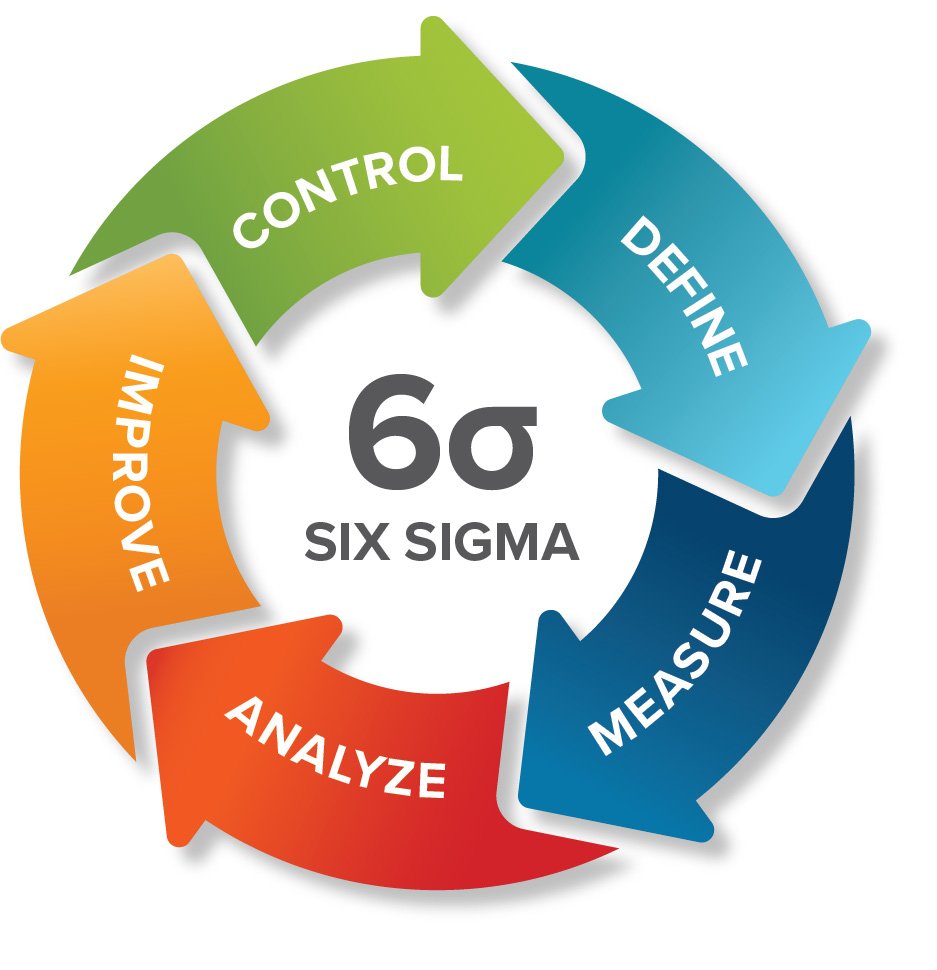
Sigma is a letter from the Greek alphabet used to express the measurement of deviation in the execution of a process from the standard of perfect performance. The standard deviation is an indicator describing dispersion or inconsistency in a specific process relative to the desired goals.
Six Sigma Methodology
Dr. Abdulrahman Al-Jamous
What is Six Sigma?
Sigma is a letter from the Greek alphabet used to express the measurement of deviation in the execution of a process from the standard of perfect performance. The standard deviation is an indicator describing dispersion or inconsistency in a specific process relative to the desired goals.
6σ
Six Sigma is a method used to identify sources of errors and ways to eliminate them. It is a statistical management system focused on achieving customer satisfaction, reducing waste, raising quality levels, and improving the organization's financial and temporal performance.
With the emergence of globalization, manufacturing organizations had to adapt their manufacturing strategies to changes in the global economy. Among these changes are: increased competition and rapid strategic positioning among companies within the same industry. This trend intensified in recent decades, leading to organizations' need to improve productivity and quality standards; thus, quality management programs became an urgent necessity.
The Six Sigma methodology is one of the most famous quality management programs. It emerged in the twentieth century, starting in the American manufacturing industry at Motorola in 1987. The methodology was designed and implemented to improve the company's performance using studies focused on diversifying production processes. It is a disciplined management strategy characterized by an organized approach and intensive use of statistical thinking, aiming to significantly reduce the average standard deviation in outcomes and increase corporate profitability by improving products and processes and striving to satisfy customers.
Although Motorola was the innovator of the Six Sigma methodology, this methodology gained popularity in 1994 when the CEO of General Electric (GE) at the time, Jack Welch, considered it critical in the pursuit of higher quality and greater profitability. He achieved notable successes in this, as General Electric's profits reached $10 billion during the first five years of implementation, and it is considered one of the most successful companies to implement Six Sigma. Since then, thousands of companies around the world have discovered the far-reaching benefits of Six Sigma.
So, what is the Six Sigma program?
Six Sigma is a disciplined, data-driven methodology for eliminating defects, where the value of the standard deviation does not exceed 6 degrees from specifications in any process, whether from manufacturing to transactions, or from product to service. The name Six Sigma is derived from the bell curve used in statistics, where sigma (σ) represents one standard deviation away from the mean.
A Six Sigma defect is defined as "anything outside of customer specifications." A Six Sigma opportunity is "the total quantity of opportunities for a defect to occur." It is said that the defect rate is extremely low when a process exhibits six sigma, meaning three above the mean and three below. Statistically, to achieve six sigma, the process should produce no more than 3.4 defects per million opportunities. In other words, reducing the error rate to 0.00034%, which is almost zero.
The difference between Six Sigma and other quality management programs lies in the systematic form of application of these tools and procedures and their integration with the goals and objectives of the organization as a whole. This integrates participation and commitment at all levels and functions of the organization, which becomes a key factor for the success of its implementation.
The DMAIC Methodology
The key elements of the Six Sigma infrastructure are the creation of teams to implement projects that strongly contribute to achieving the company's strategic goals. These projects are implemented based on the so-called DMAIC cycle. The letters in the DMAIC acronym represent the five phases that make up the defect elimination process, which is an integral part of a Six Sigma initiative. However, it can generally be implemented as an independent quality program or part of other improvement initiatives, such as Lean Management. Each stage of the cycle has a different set of tasks and goals. Here is a closer look:
In each phase of the DMAIC cycle, specific statistical analysis tools are used, which in turn reduce the design cycle time and its total cost due to reduced design changes, reduce the total time for product development because the focus is only on meeting key customer needs, which improves customer satisfaction as the development process is driven by the voice of the customer. Additionally, the product is classified against other products in the market through competitor analysis and documenting specific competitive marketing strategies.
The statistical analysis tools used are as follows:
Six Sigma Belts
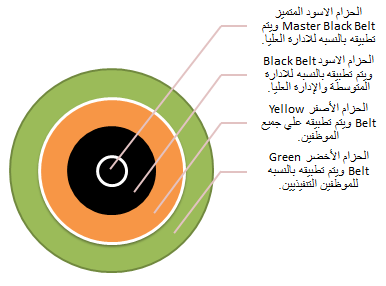
Six Sigma projects use an organized hierarchical structure to obtain certification by following a system of colored belt tiers. The following is a list of the components of this hierarchy and a description of their functions. These are the Six Sigma belts and certification levels you can achieve:
Six Sigma Belts
Work groups are entrusted with applying the Six Sigma methodology in process improvement projects. Each of these individuals must possess a specific level of knowledge and authority in implementing Six Sigma improvement projects. Each level is called a belt.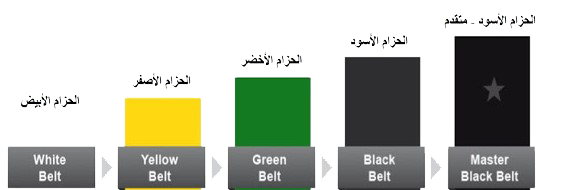
Goal of the Six Sigma DMAIC Methodology
The main goal is to follow a strategy to improve employees' capabilities and raise their problem-solving skills by focusing on improving processes and reducing variation in their performance method and time to stabilize the performance level, then continuously improving processes. Therefore, the methodology follows an approach known by the acronym DMAIC.
D = Define: Defining improvement activity goals at the senior management level. The goals will be strategic for the organization, such as a higher rate of return on investment or a larger market share. At the operational level, the goal may be to increase production efficiency. At the project level, goals may be to reduce the defect level, applying data processing methods to identify potential opportunities for improvement.
M = Measure: Measuring the current system. Making reliable measurements to help measure progress towards the goals known from the previous phase, starting by finding the current status using data and its analysis to help understand the data.
A = Analyse: Analyzing the system to identify ways to reduce the existing gap between the current performance of the system/process and the desired goals, applying statistical tools in the analysis.
I = Improve: Improving the system. Be creative in identifying new ways to do things better, cheaper, and faster. Use project tools and other planning and management methods to implement the new concept.
C = Control: Controlling the new system and deploying it by modifying incentives and the system of policies and procedures, MRP, budgeting, work instructions, and other management systems.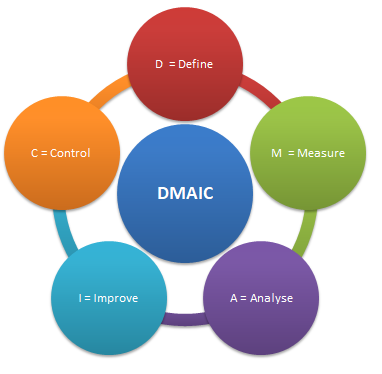
Companies and Institutions that Train and Grant Six Sigma Certification
It has been found that there are companies and institutions that train and grant Six Sigma certification, and each of these companies has Six Sigma standards and knowledge content that somewhat differs from the others. Among these entities, for example but not limited to:
Focus on the Customer: In the philosophy of the Six Sigma methodology, customers include both external customers and employees within the organization. The continuity and success of the organization depend on meeting their needs and expectations. Six Sigma places the highest priority on focusing on customers, starting with studying customer requirements and expectations and ending with studying customer satisfaction with the product or service.
Decisions Based on Facts and Data: Six Sigma helps the organization obtain better data, as these organizations evaluate performance by focusing on realistic and sufficient data that reflects customer requirements, cost containment, and defect reduction.
Focus on Internal Processes and Activities: When applying Six Sigma, every operational procedure constitutes a process in itself, whether it is designing products and services, measuring performance, improving effectiveness, or satisfying customers. Therefore, when focusing on the services provided, performance, customer satisfaction, and continuous improvement, Six Sigma places the process and considers it the fundamental axis that helps the organization achieve continuous success.
Effective Management Based on Prior Planning: This means that successful management seeks to address the problem before it occurs. In other words, there are administrative and technical measures taken before the problem occurs to avoid it. Addressing problems before they occur means setting ambitious goals, continuously reviewing these goals, setting clear priorities, and focusing on a preventive approach to avoid problems rather than treating them.
Unlimited Cooperation: The element of cooperation is one of the vital elements that helps achieve success and improve teamwork at all administrative levels of the organization, and with sales agents and customers. Six Sigma emphasizes the importance of cooperation between different administrative levels in the organization instead of competition between them. Through cooperation, departments can know the needs of other departments for financial, technical, and other resources that help support the organization's continuous improvement process.
Continuous Improvement: The philosophy of Six Sigma emphasizes the importance of continuous improvement for organizations that desire development. This principle is based on the hypothesis that work is the result of a series of interconnected steps and activities that ultimately lead to a final outcome. The idea of continuous improvement stems from the principle of developing knowledge in administrative and technical dimensions and taking the necessary measures for that development. Continuous improvement is an important element in reducing deviations that occur in the technical process, which helps maintain performance quality and increase productivity.

Dr. Abdulrahman Aljamouss, PhD is a strategic consultant, academic, trainer, and author with over 20 years of professional experience in workforce development, leadership capability building, and institutional transformation. He partners with organizations to design future-ready strategies, develop leadership pipelines, and deliver measurable, sustainable impact.



Dr. Abdulrahman Aljamouss, PhD is a strategic consultant, academic, trainer, and author with over 20 years of professional experience in workforce development, leadership capability building, and institutional transformation. He partners with organizations to design future-ready strategies, develop leadership pipelines, and deliver measurable, sustainable impact.

© Copyright - Dr. Abdulrahman Aljamouss, PhD
Powered & Designed with by Synapze

Dr. Abdulrahman Aljamouss, PhD is a strategic consultant, academic, trainer, and author with over 20 years of professional experience in workforce development, leadership capability building, and institutional transformation. He partners with organizations to design future-ready strategies, develop leadership pipelines, and deliver measurable, sustainable impact.