The decision-making and decision-taking process is a mental process through which the appropriate decision is reached. It is based on choosing from among several alternatives, where the selected alternative represents the decision. There must also be a goal behind the decision, which is to solve a problem or modify an existing situation.
The decision-making and decision-taking process is a mental process through which the appropriate decision is reached. It is based on choosing from among several alternatives, where the selected alternative represents the decision. There must also be a goal behind the decision, which is to solve a problem or modify an existing situation.
What is meant by decision-making?
In its simplest definition, decision-making is the process of successful choice between two things. As a term in the business field, it refers to the ability to choose between two or more solutions for a specific problem. Decision-making relies on one or both of the following factors:
The Difference Between the Decision-Making Process and Decision-Taking Process
Decision-Taking Process: This is the act of choosing the best alternative to solve a problem after comparing the available and possible alternatives.
Decision-Making Process: This refers to all the steps required for the decision to come into existence. It includes the steps of recognizing and defining the problem, analyzing and evaluating the problem, gathering data, proposing suitable solutions, and evaluating each solution individually.
Factors Influencing Decision-Making
Why We Sometimes Make Wrong Decisions
Requirements of a Decision
Steps of Decision-Making
First: Identifying the Problem
The decision-making process usually begins with observing the emergence or existence of a problem or that there is a favorable opportunity to make a decision concerning an individual, group, or organization. This is therefore one of the most important steps in decision-making. A manager often faces three types of administrative problems:
Traditional Problems: Those related to daily activities and tasks, their implementation procedures, and determining their steps.
Vital Problems: Related to issues that have a significant impact on the workflow and regularity within the organization, and thus on achieving the set goals.
Emergent Problems: Those that occur incidentally due to changes in the organization's surrounding environment or due to shortcomings in the organization's policies.
Second: Gathering Information
In this step, we gather information that we expect will help us define the problem so we can develop appropriate alternatives to solve it.
This information includes:
Objective Information: Here, we try to uncover the parties involved in the problem, the time and place of its occurrence, and the frequency of its occurrence in the past.
Subjective Information: Information describing our opinions, attitudes, and feelings towards the problem.
Information related to obstacles that prevented solving the problem in the past and which are likely to persist.
Third: Proposing Alternatives and Selecting the Appropriate One
This step from the general decision-making model represents the core of creativity in problem-solving. It primarily depends on the ability of the individual or group to propose more than one alternative to solve the problem. It has various names, including proposing solutions or brainstorming.
Innovative Methods for Searching for Alternatives
Brainstorming Method: This method focuses on generating many ideas and alternatives quickly. It relies on developing numerous solutions and discussing them to reach the best one.
Delphi Method: Characterized by the fact that participating members contribute their information and opinions without meeting each other. Communication is conducted through a group of observers (communication organizers - coordinators).
Stepladder Method: In this method, a group is formed to discuss and propose alternatives. Then, a new member is added who attempts to raise questions about the alternatives reached and then proposes a new alternative, and so on.
Innovative Challenge Method: This rejects traditional solutions to reach better alternatives. It means rejecting the logic that says: "The current situation is the best alternative" and refusing to accept the status quo.
Concept Fan Method: Focuses on dividing the main concept behind a specific topic into a number of sub-concepts, and dividing each sub-concept into a number of ideas.
Criteria for Evaluating Alternatives
Fourth: Implementing the Solution
This step involves applying what was chosen to solve the problem. Note that implementing any alternative or solution is not a simple process. The task of implementing the solution should be assigned to the person or persons who have sufficient skills to implement it, while giving them the authority and flexibility to implement the solution in a way that suits the implementation conditions.
Fifth: Monitoring the Implementation of the Solution
When implementing a solution to any problem, it is necessary to monitor and follow up on the implementation of this solution to determine its effectiveness in treating the problem. If the decision to choose this solution is effective in solving the problem, then this means we have reached the final stage of the problem-solving process and that our decision was largely sound.
The Decision-Making Process and the Decision-Taking Process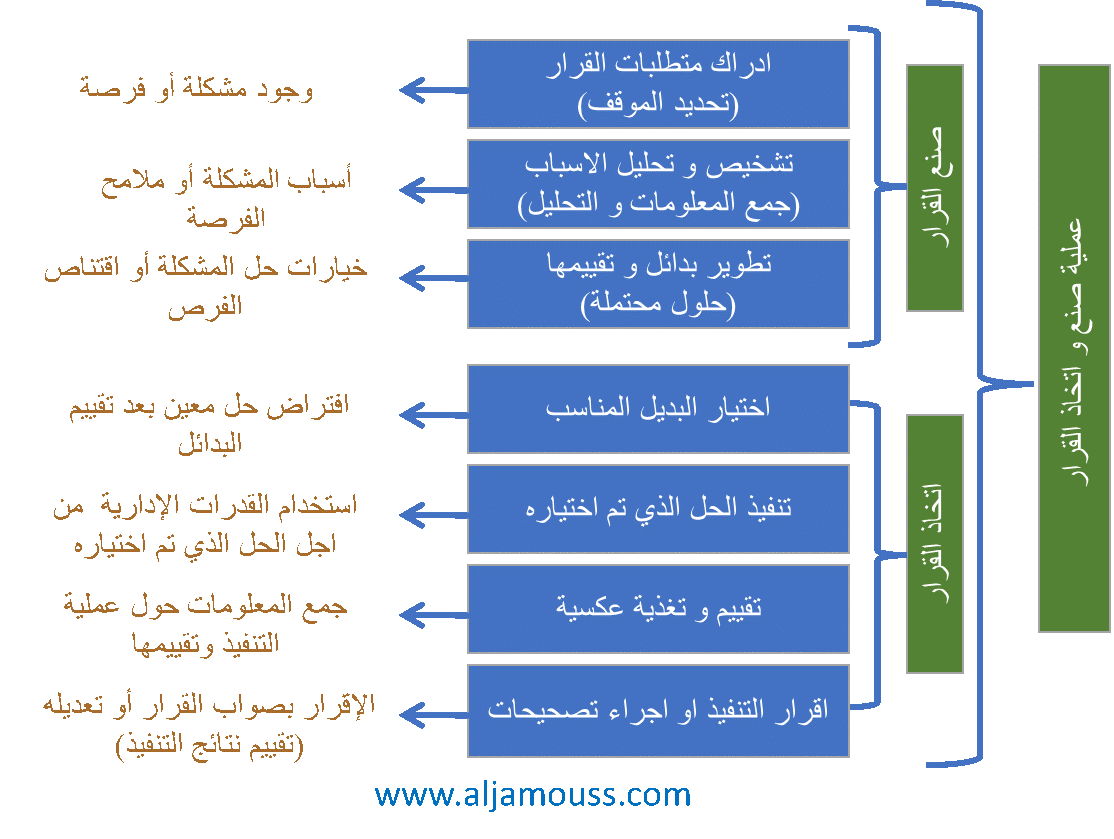
Obstacles to Decision-Making:
Types of Decisions
Programmed Decisions: These are decisions planned in advance and defined by the organization's rules and procedures, which detail how to handle a routine, recurring, and known problem. It can be said that there is a high degree of certainty about the decision's outcome and its effect in treating the problem.
Non-Programmed Decisions: These are characterized as unplanned and not predetermined. They also address unknown or new problems for which routine and regulatory methods cannot be followed for treatment. Consequently, it can be said that there is a high degree of uncertainty about the decision's impact on solving the problem.
There are other types of decisions:

Dr. Abdulrahman Aljamouss, PhD is a strategic consultant, academic, trainer, and author with over 20 years of professional experience in workforce development, leadership capability building, and institutional transformation. He partners with organizations to design future-ready strategies, develop leadership pipelines, and deliver measurable, sustainable impact.



Dr. Abdulrahman Aljamouss, PhD is a strategic consultant, academic, trainer, and author with over 20 years of professional experience in workforce development, leadership capability building, and institutional transformation. He partners with organizations to design future-ready strategies, develop leadership pipelines, and deliver measurable, sustainable impact.

© Copyright - Dr. Abdulrahman Aljamouss, PhD
Powered & Designed with by Synapze

Dr. Abdulrahman Aljamouss, PhD is a strategic consultant, academic, trainer, and author with over 20 years of professional experience in workforce development, leadership capability building, and institutional transformation. He partners with organizations to design future-ready strategies, develop leadership pipelines, and deliver measurable, sustainable impact.