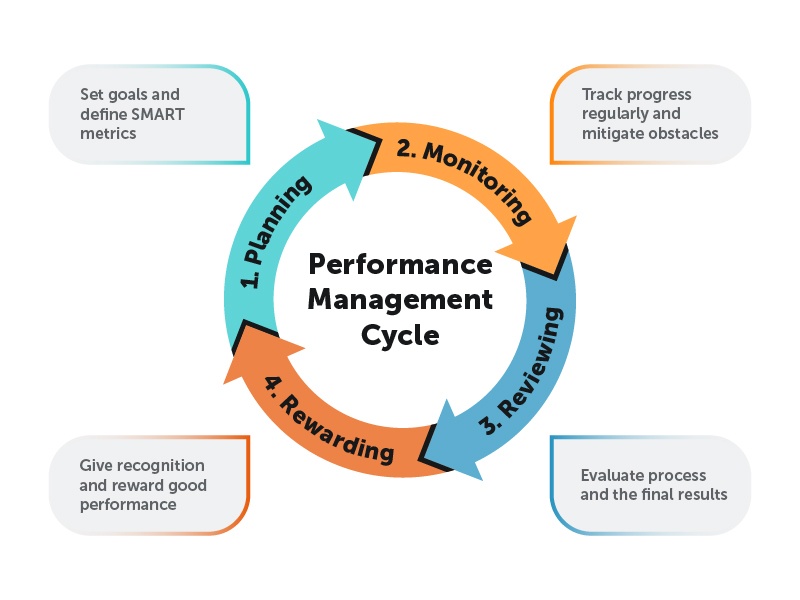
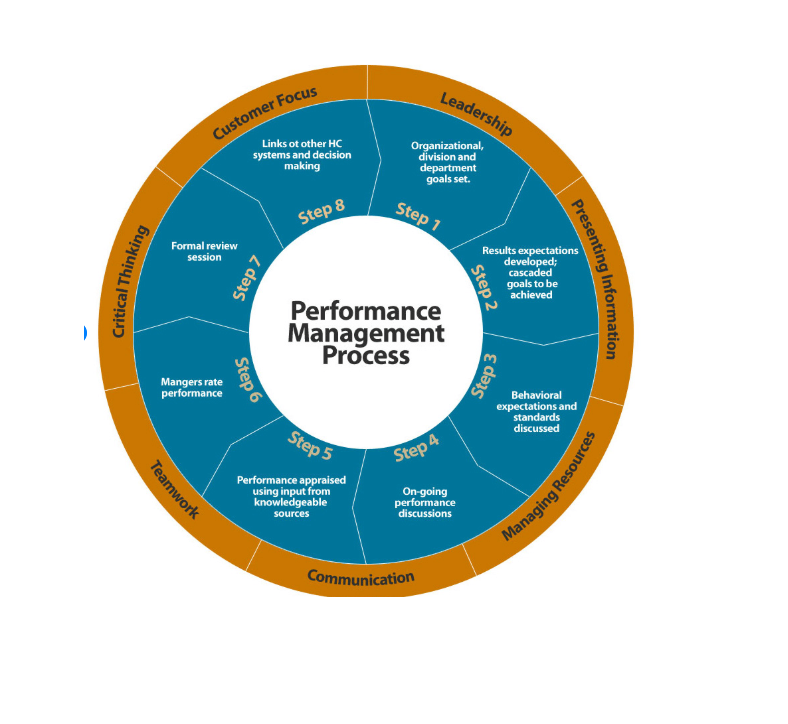
Performance represents the combined outcome of the efforts exerted by management and employees. No administrative or organizational theory is free from an implicit or explicit assumption linking it to organizational performance. If an organization aims to achieve optimal results from managing its performance and the performance of its employees, it must establish a comprehensive performance system. Performance management implies a managerial commitment to employees to achieve specific objectives through clear responsibilities linked to key business drivers. According to Payant (2006), senior management teams can, through effective performance management, measure strategic performance based on business strategies (Rebecca Cooper, 2007).
Performance Management differs from Performance Appraisal. Appraisal occurs when a manager or other parties prepare a direct report on performance, whereas performance management represents an ongoing process. Kotter and Heskett (1992) identified the parties involved in performance by defining a performance management system that requires managers and employees to engage in several activities, including:
Developing performance plans for employees with continuous discussions, tracking, and review.
Training to help employees and partners achieve expected performance.
Conducting urgent and periodic discussions comparing actual performance with targets.
Discussing future directions for individual development activities.
When dealing with performance management systems—whether technical or conventional—feedback becomes highly valuable, reflecting the strong linkage between performance management and feedback. Feedback supports effective decision-making even when information is incomplete. Performance management plays a vital role, especially when feedback systems are poorly designed (Sujay Parekh, 2010).
Performance management is among the most important managerial activities in any organization and a key tool for achieving strategy. Proper implementation leads to achieving strategic objectives and satisfying stakeholders, while poor implementation can lead to negative organizational outcomes (Al-Dahleh, 2006).
According to the UCSD Human Resources Department, performance management is a continuous communication process between the manager and employee, including:
Defining and describing key job responsibilities and linking them to organizational mission and goals.
Developing realistic and appropriate performance standards.
Exchanging feedback on performance.
Planning learning and development opportunities.
Performance management is a comprehensive system and a tool for developing individuals and teams to enhance organizational effectiveness. Armstrong and Baron (1998) define it as a partnership between managers and individuals that promotes dialogue and shared understanding of future performance expectations.
Organizational effectiveness refers to the organization’s ability to achieve short- and long-term goals while balancing stakeholder interests and organizational development stages.
Some scholars view performance management as a process based on agreement over goals rather than blind compliance with authority. The real managerial problem lies in the gap between actual performance and desired performance (performance gap). Closing this gap can be achieved by either improving actual performance (positive approach) or lowering standards (negative approach). Organizations naturally pursue the first option.
Key dimensions of performance include:
Required vs. actual performance level
Performance gap
Performance improvement as a strategic objective
According to Robert Simons (2005), achieving high performance requires answering four core questions:
What resources must be controlled to achieve the mission?
What metrics are used to measure performance?
With whom must we interact to achieve objectives?
What level of organizational support is available?
Organizational performance is a continuous holistic activity aimed at aligning the organization with its environment and utilizing resources to achieve long-term goals.
Main Steps of the Performance Management Process
The overall objective of a performance management system is to ensure that all organizational units operate coherently to achieve desired results. This requires:
Identifying and prioritizing desired outcomes and establishing measurement systems.
Continuous exchange of feedback.
Periodic review of progress and reinforcement of successful practices.
Intervention when improvement is required.
Performance Management Approaches
Key approaches include:
Benchmarking
Reengineering
Empowerment
Value Engineering
Total Quality Management (TQM)
Balanced Scorecard: Origin and Development
The Balanced Scorecard (BSC) emerged to address limitations in traditional financial control systems, which focused excessively on costs and historical data (Rieman, 2003). With increasing complexity after World War II, financial measures proved insufficient for strategic guidance. The 1980s introduced concepts such as TQM, Kaizen, and Business Process Reengineering.
Kaplan and Norton pioneered the BSC in the early 1990s. Its development was influenced by:
Quality management advancements.
Expanding performance dimensions beyond finance.
Reduced reliance on traditional accounting measures.
Emphasis on integrated information systems.
The need for forward-looking indicators rather than historical metrics.
The first balanced scorecard was implemented at Analog Devices in 1987.
Generations of the Balanced Scorecard
First Generation: Four perspectives without strong causal relationships.
Second Generation: Linking objectives with performance measures but unclear strategic ownership.
Third Generation: Strategic maps connecting objectives with cause-and-effect logic.
Concept of the Balanced Scorecard
The BSC integrates financial and non-financial measures covering customer satisfaction, internal processes, innovation, learning, and growth. It translates vision and strategy into a coherent set of performance indicators and causal relationships across four perspectives:
Financial
Customer
Internal Processes
Learning and Growth
Some scholars also add a fifth perspective: environmental and social performance.
The BSC helps:
Measure organizational performance holistically.
Balance short- and long-term objectives.
Align strategy with measurement.
Importance of the Balanced Scorecard
According to Harvard Business Review (1992), the BSC is among the most influential management concepts. Its benefits include:
Supporting future-oriented decision-making.
Linking strategy with operational actions.
Identifying areas of competitive advantage.
Integrating improvement programs.
Enhancing stakeholder involvement.
Clarifying vision and linking rewards to performance.
Dimensions of Balanced Performance Measurement
Time Dimension: Past, present, and future.
Strategic Dimension: Linking operational control with long-term strategy.
Environmental Dimension: Internal and external stakeholders.
Components of the Balanced Scorecard
Each perspective includes:
Objectives
Measures
Targets
Initiatives
Functions and Characteristics of the BSC
Functions include:
Translating vision and strategy.
Linking objectives with measures.
Strategic planning and alignment.
Key characteristics:
Clear cause-and-effect relationships.
Effective strategy communication.
Emphasis on both financial and operational indicators.
Risks of the Balanced Scorecard
Weak causal linkage between indicators.
Difficulty in continuous improvement.
Reliance on subjective measures.
Potential undervaluation of financial measures.
Steps for Implementing the BSC
Define organizational vision.
Formulate strategies and objectives.
Identify critical success factors.
Select measures.
Develop action plans.
Execute initiatives.
Monitor and improve.
Performance Measurement Perspectives
Four main measurement groups:
Financial performance (ROI, EVA, NPV).
Customer satisfaction.
Internal processes.
Learning and growth.
Performance Measurement Concepts
Performance measurement enables organizations to control and evaluate progress toward goals. Effective systems combine financial and non-financial indicators, internal and external measures, and short- and long-term metrics.
Behavior, Achievement, and Performance
Performance is the interaction between behavior and achievement. Ineffective behaviors should be corrected or eliminated. Performance is influenced by:
Knowledge, Skills, and Attitudes (KSAs)
Motivation
Environment
Performance = KSAs + Motivation + Environment
Strategic Performance Management Models
Key models include:
Labovitz & Rosansky
Olve & Sjoostrand
Kaplan & Norton
Strategic performance management translates vision and strategy into measurable results through defined indicators, targets, measurement processes, and feedback mechanisms.
Performance represents the combined outcome of the efforts exerted by management and employees. No administrative or organizational theory is free from an implicit or explicit assumption linking it to organizational performance. If an organization aims to achieve optimal results from managing its performance and the performance of its employees, it must establish a comprehensive performance system. Performance management implies a managerial commitment to employees to achieve specific objectives through clear responsibilities linked to key business drivers. According to Payant (2006), senior management teams can, through effective performance management, measure strategic performance based on business strategies (Rebecca Cooper, 2007).
Performance Management differs from Performance Appraisal. Appraisal occurs when a manager or other parties prepare a direct report on performance, whereas performance management represents an ongoing process. Kotter and Heskett (1992) identified the parties involved in performance by defining a performance management system that requires managers and employees to engage in several activities, including:
When dealing with performance management systems—whether technical or conventional—feedback becomes highly valuable, reflecting the strong linkage between performance management and feedback. Feedback supports effective decision-making even when information is incomplete. Performance management plays a vital role, especially when feedback systems are poorly designed (Sujay Parekh, 2010).
Performance management is among the most important managerial activities in any organization and a key tool for achieving strategy. Proper implementation leads to achieving strategic objectives and satisfying stakeholders, while poor implementation can lead to negative organizational outcomes (Al-Dahleh, 2006).
According to the UCSD Human Resources Department, performance management is a continuous communication process between the manager and employee, including:
Performance management is a comprehensive system and a tool for developing individuals and teams to enhance organizational effectiveness. Armstrong and Baron (1998) define it as a partnership between managers and individuals that promotes dialogue and shared understanding of future performance expectations.
Organizational effectiveness refers to the organization’s ability to achieve short- and long-term goals while balancing stakeholder interests and organizational development stages.
Some scholars view performance management as a process based on agreement over goals rather than blind compliance with authority. The real managerial problem lies in the gap between actual performance and desired performance (performance gap). Closing this gap can be achieved by either improving actual performance (positive approach) or lowering standards (negative approach). Organizations naturally pursue the first option.
Key dimensions of performance include:
According to Robert Simons (2005), achieving high performance requires answering four core questions:
Organizational performance is a continuous holistic activity aimed at aligning the organization with its environment and utilizing resources to achieve long-term goals.
The overall objective of a performance management system is to ensure that all organizational units operate coherently to achieve desired results. This requires:
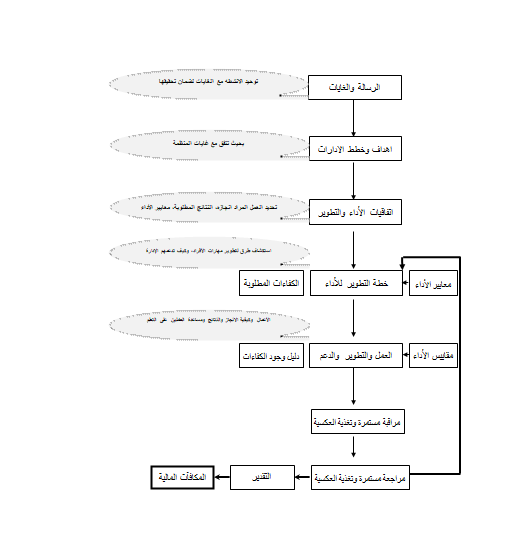
Key approaches include:
The Balanced Scorecard (BSC) emerged to address limitations in traditional financial control systems, which focused excessively on costs and historical data (Rieman, 2003). With increasing complexity after World War II, financial measures proved insufficient for strategic guidance. The 1980s introduced concepts such as TQM, Kaizen, and Business Process Reengineering.
Kaplan and Norton pioneered the BSC in the early 1990s. Its development was influenced by:
First Generation: Four perspectives without strong causal relationships.
Second Generation: Linking objectives with performance measures but unclear strategic ownership.
Third Generation: Strategic maps connecting objectives with cause-and-effect logic.
The BSC integrates financial and non-financial measures covering customer satisfaction, internal processes, innovation, learning, and growth. It translates vision and strategy into a coherent set of performance indicators and causal relationships across four perspectives:
Some scholars also add a fifth perspective: environmental and social performance.
The BSC helps:
According to Harvard Business Review (1992), the BSC is among the most influential management concepts. Its benefits include:
Time Dimension: Past, present, and future.
Strategic Dimension: Linking operational control with long-term strategy.
Environmental Dimension: Internal and external stakeholders.
Each perspective includes:
Functions include:
Four main measurement groups:
Performance measurement enables organizations to control and evaluate progress toward goals. Effective systems combine financial and non-financial indicators, internal and external measures, and short- and long-term metrics.
Performance is the interaction between behavior and achievement. Ineffective behaviors should be corrected or eliminated. Performance is influenced by:
Key models include:
Strategic performance management translates vision and strategy into measurable results through defined indicators, targets, measurement processes, and feedback mechanisms.

Dr. Abdulrahman Aljamouss, PhD is a strategic consultant, academic, trainer, and author with over 20 years of professional experience in workforce development, leadership capability building, and institutional transformation. He partners with organizations to design future-ready strategies, develop leadership pipelines, and deliver measurable, sustainable impact.




Dr. Abdulrahman Aljamouss, PhD is a strategic consultant, academic, trainer, and author with over 20 years of professional experience in workforce development, leadership capability building, and institutional transformation. He partners with organizations to design future-ready strategies, develop leadership pipelines, and deliver measurable, sustainable impact.

© Copyright - Dr. Abdulrahman Aljamouss, PhD
Powered & Designed with by Synapze

Dr. Abdulrahman Aljamouss, PhD is a strategic consultant, academic, trainer, and author with over 20 years of professional experience in workforce development, leadership capability building, and institutional transformation. He partners with organizations to design future-ready strategies, develop leadership pipelines, and deliver measurable, sustainable impact.